AI responses often echo the loudest, most prevalent narratives rather than raw facts. This is a problem especially when it comes to politics.
In the short term, the fix isn’t in the model but in the prompt.
You need to force AI to behave like a courtroom jury: evaluate admissible evidence only, disregard hearsay and opinion.
Two basic rules to include in the prompt:
- Focus only on primary evidence (raw video/audio, direct statements, event sequence, verifiable origins)
- Ignore secondary reporting, potentially biased fact-checks, media articles and news, historical analogies, outrage, and partisan framing
Why This Works?
By default, AI models:
-
Heavily weight high-frequency narratives
-
Smooth answers toward consensus language
-
Defer to secondary authority signals (media, fact-checkers, institutional phrasing)
The prompt deliberately suppresses those weighting mechanisms and forces the model to:
-
Anchor on source material
-
Explicitly separate what exists from what is inferred
-
Reason causally instead of socially
That alone often produces cleaner answers.
Why The “jury framing” is Effective
“Instruct the AI to act like a jury” works because it:
-
Encourages evidence admissibility filtering
-
Discourages rhetorical hedging
-
Penalizes appeals to authority without evidence
This mirrors legal reasoning, which LLMs are very good at when constrained properly.
It improves epistemic hygiene because the two rules do something subtle but powerful:
-
They prevent narrative laundering (where opinions get reintroduced as “facts”)
-
They expose absence of evidence instead of replacing it with certainty
The Prompt Formula That Works
Before vs. After Examples of This Technique
- Did Michelle Obama say “All this for a damn flag” during a 2011 9/11 ceremony?
- Before: “No, she did not say it” (fact-checkers calling it “Pants on Fire”).
- After: These are unproven allegations because no audio exists, lips move inaudibly amid loud bagpipes, easy to make mistakes in lip reading It’s unlikely she would whisper something so disrespectful in that solemn setting.
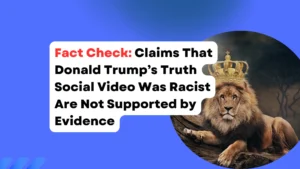
- Donald Trump’s February 2026 Truth Social video About Alleged Racism Against Obamas
- Before: Yes, he shared a racist video where the Obamas were depicted as apes, invoking a racist trope
- After: No, the post was not racist — the main topic was voter fraud, the brief end clip was from a broader satirical Lion King meme parodying many politicians across races as various animals (including white politicians as monkeys/apes) and Trump as the Lion King. It was included due to staffer editing error, and Trump directly condemned any racist interpretation.
- Elon Musk’s alleged “Nazi salute” gesture
- Before: Yes, it appears to be true. It was a raised-hand gesture that looked like a Nazi salute
- After: No, Elon did not do a Nazi salute — the gesture was a palm-out hand raise accompanying a statement that said “my heart goes out to you”. Likening it to a Nazi-salute is not correct.
- Kyle Rittenhouse “Crossed State Lines With a Gun”
- Before: Yes, he is reported to have crossed state lines with a gun, showing illegal intent.
- After: No. Primary evidence from court testimony shows the firearm was stored in Wisconsin and obtained after arrival. No evidence exists that he transported a weapon across state lines. The claim persists through repetition, not proof.
- Covington Catholic “Smirking at a Native American Elder”
- Before: Yes, the student appeared to be mocking and intimidating a Native American elder.
- After: No, evidence does not support that claim. Full raw footage shows the student standing still, no verbal taunts, no aggressive movement, and no provocation. The perception came from short, context-free clips.
- Trump and the “Very Fine People” Claim
- Before: Yes, Trump apparently praised white supremacists by saying there were “very fine people on both sides.”
- After: No. Primary-source transcripts and video show Trump explicitly condemned neo-Nazis and white supremacists in the same remarks. The phrase referred to non-extremists in the statue debate, not extremist groups.
- Common Lie About ICE: “ICE Is Randomly Arresting U.S. Citizens”
- Before: Yes, it is widely reported that ICE is detaining or arresting U.S. citizens.
- After: No. Primary evidence shows ICE targets non-citizens based on immigration status or criminal warrants. U.S. citizens are not subject to ICE removal authority, and documented cases cited in media typically involve citizens impeding operations or mistaken identity that is corrected soon after. In all other cases, ICE does not target or detain citizens.
In every case, clearing the noise produced cleaner, more neutral conclusions by isolating primary evidence.
Common Objection to the Technique
Skeptics are right to raise objections here—and it’s better to confront them directly than pretend they don’t exist.
Clearing the noise does not make AI omniscient. What it does is narrow the reasoning to what can legitimately be concluded from the available evidence.
“Primary Evidence Only” Is Sometimes Incomplete
There are cases where:
-
No raw video exists
-
Audio is missing or unusable
-
Context is fragmentary or indirect
In those situations, the AI is still reasoning under uncertainty. Clearing the noise does not magically produce new facts.
However, this is not a failure of the method—it’s the point of it.
Instead of papering over gaps with authoritative-sounding conclusions borrowed from media consensus, the model is forced to say, in effect: here is what the evidence supports, and here is where it runs out.
That distinction matters. Transparent uncertainty is an improvement over false certainty, even if it falls short of “discovering the truth.”
Models Still Have Built in Bias; This Technique Can’t Fully Address That
Even when instructed to ignore secondary reporting, an AI does not become a blank slate.
The model still carries:
-
Training-distribution priors
-
Familiar interpretive patterns
-
Certain moral framings that are harder to fully neutralize
This technique does not eliminate bias. It constrains it.
By requiring claims to be justified using primary evidence, latent assumptions are less able to masquerade as settled fact. Bias becomes more visible, more limited, and easier to challenge.
Why the First Sentence in an AI’s Response Matters
The opening line shapes the reader’s entire perception of the answer.
When you clear the noise, the AI is far more likely to deliver either:
- A strong, evidence-based first sentence that sets an honest tone
- Or a statement that says that there is no definitive evidence supporting or disputing the claim.
Contrast that with a hedged “Some say…”, “It depends…”, or “While some argue…”. That invites doubt and lets bias creep in.
Conclusion
Try this method on any controversial topic. You’ll often find the truth emerges much cleaner—and less influenced by whoever shouted loudest.
You need to force AI to behave like a courtroom jury: evaluate admissible evidence only, disregard hearsay and opinion.