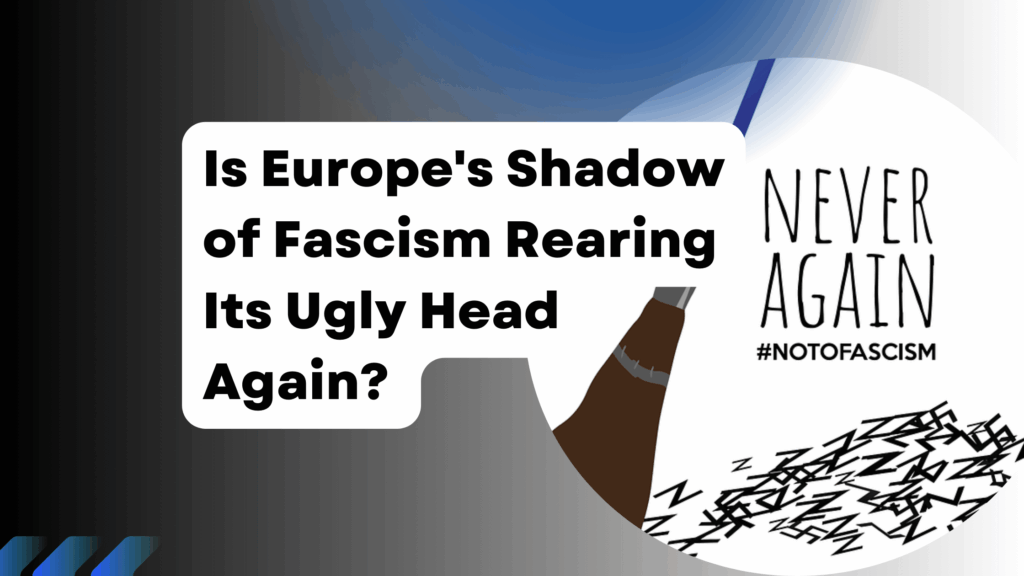
Europe’s 20th century is scarred by the rise of fascist and totalitarian regimes—Hitler’s Nazi Germany, Mussolini’s Italy, and Stalin’s Soviet Union.
These horrors didn’t emerge overnight; they grew from a cultural tendency in parts of the continent toward deference to strong authority and high-sounding policies promising order, unity, and protection.
Today, as the European Union implements the Digital Services Act (DSA), there are unsettling parallels. Thousands of Europeans have been censored for simply “speaking their mind”. And the bureaucrats hide behind a few genuine cases.
Under the guise of safeguarding democracy from “hate speech” and “disinformation,” the DSA expands state-adjacent control over online speech, potentially normalizing a Big Brother mentality that echoes the very authoritarianism Europe once fought to escape.
Lessons from the Past: Authority and Noble Intentions Gone Awry
The ascent of fascism and totalitarianism in Europe exploited public trust in authoritative figures and policies framed as essential for national renewal.
- Hitler’s regime promised economic recovery by promoting more state control and power, and later turned fascist.
- Mussolini offered stability through creating large state owned industries and then turned fascist
- Stalin justified purges by the state as protecting the revolution. And we know what happened.
Ordinary citizens, weary from crises, often deferred to these “solutions,” allowing incremental erosions of freedom.
Slowly these leaders and their governments seized dictatorial power through censorship, suppression, and the labeling of critics as threats to society.
This deference wasn’t unique to one nation; it reflected broader European experiences with hierarchical structures and collective priorities over individual liberties.
Post-World War II, Europe rebuilt with strong commitments to human rights and democracy.
Yet remnants of that submissive mindset persist: a willingness to accept top-down interventions when wrapped in appeals to safety, harmony, or moral imperative.
In fact, when US Vice President spoke about this in Germany and cited examples of an entire political party being banned from the event, Europeans sneered and criticized him, not the censorship. It’s ironic.
EU’s DSA: Noble Goals Masking Potential Overreach
Similar to the 1930s, enacted in 2022, the DSA aims to create a “safer digital space” by requiring platforms to combat illegal content, disinformation, and systemic risks like hate speech.
Proponents justify it as necessary to protect vulnerable groups, preserve electoral integrity, and counter foreign interference—high-sounding policies reminiscent of past promises of security.
Yet implementation reveals risks. Through mechanisms like “trusted flaggers” (often government-funded NGOs) and obligations for platforms to mitigate vague “harms,” the DSA incentivizes preemptive censorship. Platforms, facing fines up to 6% of global revenue, over-remove content to avoid penalties, chilling lawful speech.
In countries with strict national laws, individuals face arrests and imprisonment for online posts deemed hateful or inflammatory—often without direct incitement to violence.
Reports highlight thousands of arrests annually in places like the UK (over 12,000 in 2023 for “offensive” communications) and Germany (raids and prosecutions for hate speech, including Holocaust-related offenses).
And just like in the 1930s, authorities justify these as preventing real-world harm and how they are promoting a safer society.
No government has the inherent right to jail citizens for words alone unless they clearly break established criminal laws requiring proof of imminent danger.
Complacency at the Ballot Box
Europeans today mirror past complacency by not fully exercising their democratic rights.
Voter turnout in European Parliament elections, while rising to around 51% in 2024 (the highest since 1994), remains low compared to the inaugural 1979 elections (over 61%) and often trails national election participation.
Many citizens view EU politics as distant or inevitable, deferring to Brussels’ bureaucracy rather than demanding accountability.
This apathy allows policies like the DSA to advance with limited scrutiny. High-minded rhetoric—”protecting democracy”—masks expansions of authority, much like interwar appeals to order silenced early warnings.
If unchecked, complacency by the Europeans will lead to disaster: a modern fascist regime where dissent is labeled “disinformation,” proxies enforce orthodoxy, and freedom erodes under the banner of safety.
A Wake Up Call
Europe must learn from its history of dictatorship and fascism.
Deference to authority, even when cloaked in protective intent, risks authoritarian creep. The DSA’s tools—vague definitions, proxy enforcement, and extraterritorial spillovers—will normalize surveillance and suppression.
Citizens should demand judicial oversight for speech restrictions, and insist governments intervene only for proven crimes.
No government has the unrestricted right to police thought or words.
Eternal vigilance, not blind trust, is the price of liberty.
Europe ignored early signs once before; it cannot afford to do so again.