Robert F. Kennedy Jr. has never shied away from calling out systemic rot in America’s public health system.
While critics dismiss him as contrarian, Kennedy’s arguments often focus on a core truth: policies meant to protect public health have too often been captured by corporate interests.
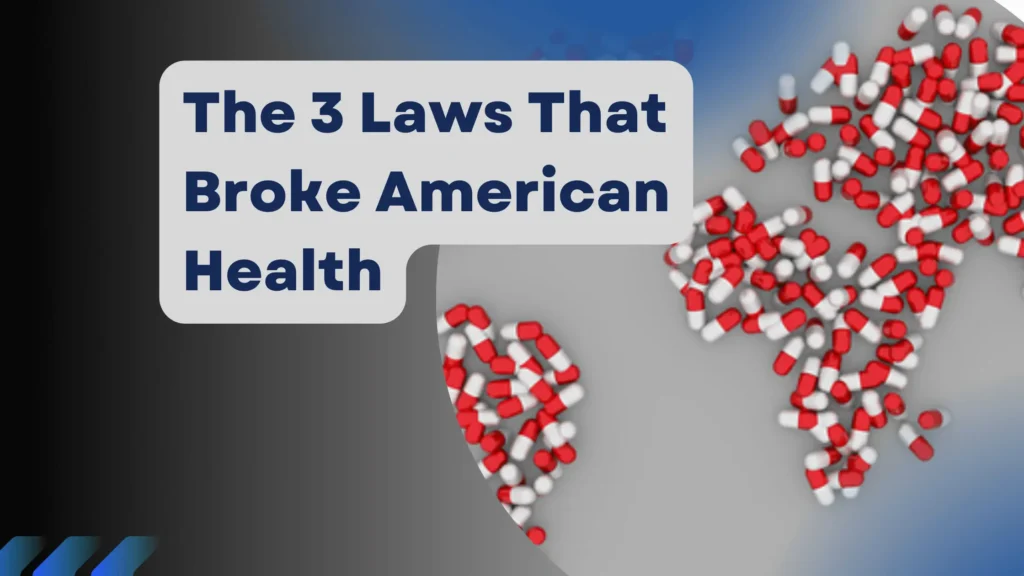
Three pivotal laws—
- the Bayh-Dole Act of 1980,
- the National Childhood Vaccine Injury Act (NCVIA) of 1986, and
- the Prescription Drug User Fee Act (PDUFA) of 1992
stand as striking examples.
Each was designed with good intentions: to promote innovation, secure vaccine supply, and speed life-saving drug approvals.
Yet their unintended consequences have arguably contributed to a declining health trajectory in America.
Together, these laws reveal how government policy can entrench conflicts of interest, diminish accountability, and ultimately prioritize pharmaceutical profits over public well-being.
The Bayh-Dole Act of 1980: From Public Research to Private Profit
The Bayh-Dole Act was a turning point in American science.
By allowing universities and nonprofits to patent inventions stemming from federally funded research, it unlocked a wave of commercialization.
The results on paper were impressive: nearly $2 trillion added to U.S. GDP and the creation of more than 11,000 startups.
But this “success” came with tradeoffs.
Instead of serving the public good, taxpayer-funded research increasingly aligned with corporate interests. For example, the NIH’s co-ownership of patents tied to the Moderna COVID-19 vaccine raised red flags about conflicts of interest.
Meanwhile, monopolistic moves like Myriad Genetics’ control over BRCA gene patents highlighted how commercialization could stifle broader scientific progress and limit access to care.
Kennedy and other critics argue that Bayh-Dole reoriented health research away from prevention and root causes toward profitable treatments.
The result?
An industry thriving on chronic disease rather than reducing it.
The National Childhood Vaccine Injury Act of 1986: Shielding Industry, Weakening Accountability
In the 1980s, vaccine manufacturers faced mounting lawsuits over injury claims, threatening vaccine supply. The NCVIA was passed to address this by removing liability from manufacturers and establishing the Vaccine Injury Compensation Program (VICP) as a no-fault system.
But what was meant as a safeguard became, in Kennedy’s words, a “blank check.”
By shielding manufacturers from lawsuits, the act removed a crucial layer of accountability. At the same time, Congress required the CDC to publish biennial reports to improve vaccine safety—a mandate that has gone unfulfilled since the law’s passage.
Families seeking justice face a difficult and limited process in vaccine court, while manufacturers, free from financial liability, have strong incentives to expand vaccine schedules without equally strong obligations to conduct thorough safety evaluations.
Critics link this dynamic to rising rates of autoimmune and neurological disorders, arguing that the system prioritizes vaccine volume over vaccine safety.
The Prescription Drug User Fee Act of 1992: FDA Capture by Industry
The Prescription Drug User Fee Act allowed pharmaceutical companies to pay the FDA to expedite drug approvals. What seemed like a reasonable solution to bureaucratic delays has evolved into a structural dependency: today, about 65% of FDA drug review funding comes from industry fees.
This funding model, Kennedy warns, blurs the line between regulator and regulated.
While PDUFA has cut approval times nearly in half, it also pressures the FDA to act more as a business partner than a watchdog.
Drugs with insufficient long-term testing reach the market faster, and the focus tilts toward high-profit products rather than truly transformative health solutions.
The broader impact?
A healthcare system overloaded with expensive drugs, treating symptoms instead of preventing disease, while chronic illnesses climb year after year.
The Bigger Picture: Policies That Made America Sicker
Since the 1980s, chronic diseases such as diabetes, obesity, and autoimmune disorders have risen at alarming rates.
While no single law explains this crisis, the Bayh-Dole Act, NCVIA, and PDUFA created an ecosystem where corporate profit consistently trumps public health.
-
Bayh-Dole commercialized taxpayer-funded science, pushing research toward profitability rather than prevention.
-
NCVIA insulated vaccine manufacturers from liability, weakening accountability mechanisms.
-
PDUFA tethered the FDA’s financial stability to the very companies it is supposed to regulate.
Kennedy’s critique is not about rejecting innovation, vaccines, or modern medicine outright—it’s about exposing a structural imbalance.
When government institutions serve as enablers of corporate power, public trust erodes, and health outcomes decline.
A Call for Reform
Kennedy’s call to “blow the cover off” these policies is not just a political slogan—it is a demand for accountability and transparency.
Reform could mean restoring public-interest safeguards to Bayh-Dole, strengthening oversight and reporting under NCVIA, and untangling FDA funding from pharmaceutical dollars under PDUFA.
Without such changes, America risks perpetuating a system where sickness is profitable and wellness is sidelined. The decline in national health since these laws were enacted is not coincidental—it is the predictable result of policies that favored industry over people.
Kennedy is right: systemic rot runs deep, and fixing it begins with confronting the laws that made America sicker.